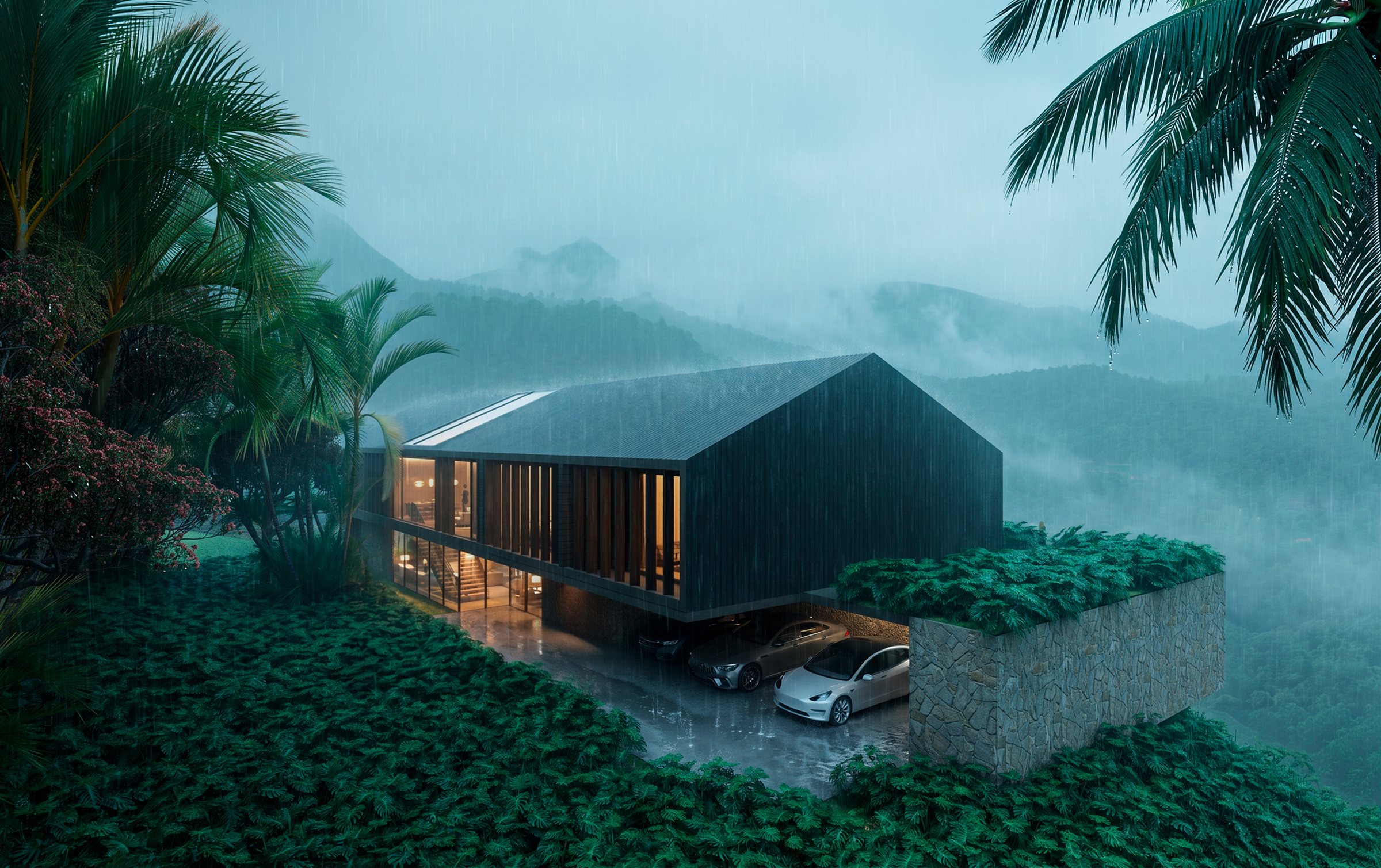
Summer storm at 5 p.m.
A heavy dark sky, wet ground that reflects, one last raking ray of sun.
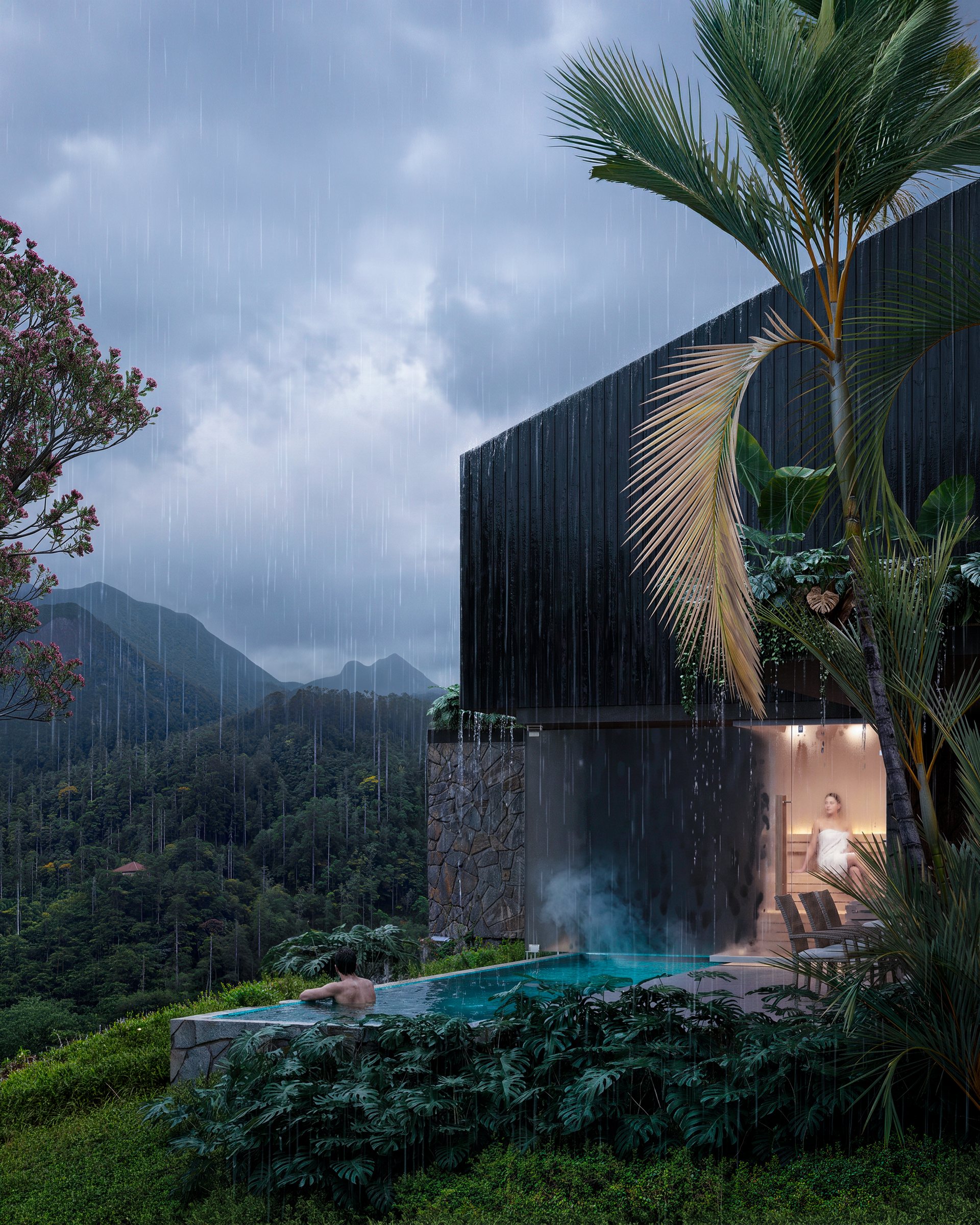
- What it sells
- Shelter. Rain outside makes the lit interior and the deep eaves feel safe.
- Best for
- Homes with big overhangs, spas and hospitality.
Late-afternoon summer storms are part of the weather in much of Brazil: a heavy sky closes in, the ground gets wet and, for a few minutes, a low sun breaks through from the side.
The drama comes from the temperature contrast: a cold, dark sky against one warm raking ray. Reflections on the wet ground double the light.
The recipe
| HDRI | storm, dense clouds |
|---|---|
| Sun | 5 to 10° elevation, from the side |
| Temp. | sun 3500 K against sky 8000 K |
| Material | floor with low roughness and puddles |
| Post | darken the sky, keep the ray of light |
Starting points for Corona or V-Ray, not rules.
Step by step in 3D
- Pick a storm HDRI with dense clouds, or darken a cloudy one until the sky is the darkest large mass in the frame.
- Place the sun low, at 5 to 10 degrees, coming from the side so it rakes across façades and ground.
- Set the sun warm, around 3500 K, against a cold sky around 8000 K.
- Make the ground wet: low roughness, puddles in the low points, a darker albedo.
- Keep one area of the building in the ray and let the rest fall into shadow.
Post-production
Darken and cool the sky, protect the warm ray from clipping and add a touch of mist near the ground for depth.
Where to study it
Saul Leiter, Turner. The reference library says what to look at in each one.
A starting phrase
Summer storm, 5:10 p.m., the first week of January. The rain has just stopped. 85 mm lens compressing the planes, a dark foreground framing the scene.
Write the moment in one sentence before you model, then check the render in the value study tool. The other six atmospheres are in the Atmosphere Notebook.